JN0-650 Reliable Mock Test, JN0-650 Pass4sure
Wiki Article
DOWNLOAD the newest Pass4sureCert JN0-650 copyright from Cloud Storage for free: https://drive.google.com/open?id=1aShhvVjUQtoUwpWKMmOSVk0tOCf7fyVO
If without a quick purchase process, users of our JN0-650 quiz guide will not be able to quickly start their own review program. So, our company employs many experts to design a fast sourcing channel for our JN0-650 exam prep. All users can implement fast purchase and use our JN0-650 learning materials. We have specialized software to optimize the user's purchase channels, if you decide to purchase our JN0-650 prepare questions, you can achieve the JN0-650 exam questions content even if the update service and efficient and convenient user experience and you will copyright for sure.
Juniper JN0-650 Exam Syllabus Topics:
| Topic | Details |
|---|---|
| Topic 1 |
|
| Topic 2 |
|
| Topic 3 |
|
| Topic 4 |
|
| Topic 5 |
|
| Topic 6 |
|
| Topic 7 |
|
>> JN0-650 Reliable Mock Test <<
Pass Guaranteed Quiz JN0-650 - Enterprise Routing and Switching, Professional (JNCIP-ENT) Perfect Reliable Mock Test
Our product backend port system is powerful, so it can be implemented even when a lot of people browse our website can still let users quickly choose the most suitable for his Enterprise Routing and Switching, Professional (JNCIP-ENT) qualification question, and quickly completed payment. It can be that the process is not delayed, so users can start their happy choice journey in time. Once the user finds the learning material that best suits them, only one click to add the JN0-650 study tool to their shopping cart, and then go to the payment page to complete the payment, our staff will quickly process user orders online. In general, users can only wait about 5-10 minutes to receive our JN0-650 learning material, and if there are any problems with the reception, users may contact our staff at any time. To sum up, our delivery efficiency is extremely high and time is precious, so once you receive our email, start your new learning journey.
Juniper Enterprise Routing and Switching, Professional (JNCIP-ENT) Sample Questions (Q21-Q26):
NEW QUESTION # 21
Exhibit
You are asked to configure VLAN load balancing on your network using MSTP. Referring to the exhibit, which two statements are correct? (Choose two.)
- A. Switch1 will be the root bridge for msti 2.
- B. Switch1 will assume the role of root bridge for both mstil and msti2 if Switch2 goes down.
- C. Switch 1 will not assume the role of root bridge for both mstil and msti2 if Switch2 goes down.
- D. Switch1 will be the root bridge for msti 1.
Answer: A,B
Explanation:
The exhibit shows the MSTP configuration for two switches,switch1andswitch2. MSTP allows you to group multiple VLANs into a single Multiple Spanning Tree Instance (MSTI), enabling different root bridges and topologies for different sets of VLANs.
* Root Bridge Election (Option B):For any Spanning Tree instance, the switch with thelowest bridge priorityis elected as the root bridge.
* Formsti 2, switch1 has a priority of4k(4096), while switch2 has a priority of8k(8192).
* Since 4096 < 8192,switch1 is elected the root bridge for msti 2.
* Failover Behavior (Option D):Spanning Tree is designed for redundancy. If a primary root bridge fails, the remaining switches in the network re-elect a new root based on the next lowest priority.
* Ifswitch2goes down, switch1 becomes the only switch in the region.
* Regardless of its original priority (4k or 8k), switch1 will take over as theroot bridge for both msti 1 and msti 2because there are no other contenders with a better (lower) priority.
* Incorrect Statements:Option Ais incorrect because for msti 1, switch2 has the lower priority (4k vs.
8k), making switch2 the root bridge.Option Cis incorrect because it contradicts the fundamental high- availability nature of Spanning Tree.
NEW QUESTION # 22
You are implementing an EVPN-VXLAN edge-routed bridging design using Layer 3 gateway operations. In this scenario, which statement is correct?
- A. Distribution switches share the same anycast IP addresses for IRB interfaces; routing occurs at the distribution layer.
- B. Only core switches have IRB interfaces; all Layer 3 routing happens in the core.
- C. IRB interfaces are disabled; all routing happens through external routers only.
- D. Each distribution switch has unique IP addresses for IRB interfaces; routing protocols run on IRB interfaces
Answer: A
Explanation:
In anEVPN-VXLAN Edge-Routed Bridging (ERB)architecture, also known as a collapsed fabric, the Layer
3 default gateway functionality is moved from the core/spine layer down to the edge (the leaf or distribution layer).
* Anycast Gateways:To support seamless host mobility and redundancy, multiple distribution/leaf switches are configured with thesame anycast IP addressandMAC addresson their IRB interfaces for a given VLAN. This allows a host to move between different switches without needing to update its default gateway configuration or ARP cache.
* Distributed Routing:Routing occurs locally at the edge (distribution layer). Traffic destined for a different subnet is routed by the first switch it hits (the ingress leaf), rather than being backhauled to a central core router.
* Symmetric vs. Asymmetric IRB:Junos OS 24.4 supports both models, but the ERB design typically utilizes symmetric routing for better scalability, where each leaf only needs to know the routes for its locally connected VNIs and uses a transit VNI for inter-subnet communication.
Option Ais incorrect because while unique IPscanbe used (Method 1 in some docs), the defining characteristic of an efficient ERB design is the use of shared Anycast IPs for the gateway.Option Cdescribes a Centrally-Routed Bridging (CRB) design, not ERB.
NEW QUESTION # 23
Exhibit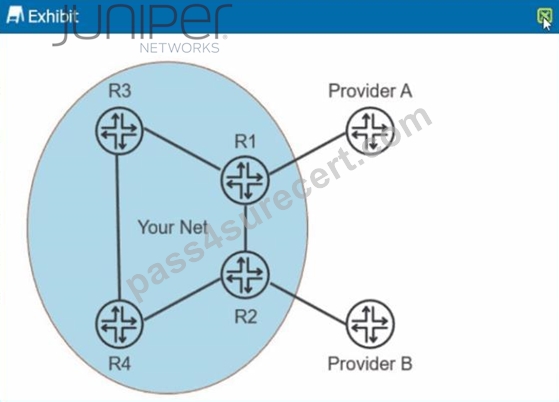
Your network receives the full Internet BGP routing table from two different ISPs. You want your local routers to use Provider A to forward all Internet traffic as long as Provider A is available.
Referring to the exhibit, which two actions would satisfy this requirement? (Choose two.)
- A. Use a routing policy to set the local preference attribute value higher for the routes that are learned by R1
- B. Use a routing policy to set the local preference attribute value lower for the routes that are learned by R1.
- C. Use a routing policy to set the local preference attribute value lower for the routes that are learned by R2.
- D. Use a routing policy to set the local preference attribute value higher for the routes that are learned by R2.
Answer: A,C
Explanation:
In BGP path selection, theLocal Preferenceattribute is one of the most common ways to influence outbound traffic from an Autonomous System (AS). It is a well-known discretionary attribute that is propagated throughout the AS to tell internal routers which path is preferred for a specific destination.
* Priority Rule: In the BGP selection algorithm, ahigher local preferencevalue is always preferred over a lower one. The default value in Junos OS is100.
* Influencing Outbound Traffic (Option A): To ensure that Provider A is always preferred, you would apply an import policy onR1(the router connected to Provider A) to set the local preference of all received routes to a value higher than the default (e.g., 200). Since 200 > 100, R3 and R4 will prefer the path via R1.
* Alternative Method (Option C): Conversely, you can achieve the same result by applying an import policy onR2(the router connected to Provider B) to set the local preference to a value lower than the default (e.g., 50). Since the routes from R1 remain at the default of 100, and 100 > 50, the path via R1 (Provider A) is preferred.
* Why B and D are incorrect: Setting a higher local preference on R2 (Option B) would make Provider B the preferred exit point. Setting a lower local preference on R1 (Option D) would make Provider A the leastpreferred exit point.
NEW QUESTION # 24
You enable the Multiple VLAN Registration Protocol (MVRP) to automate the creation and management of virtual LANs.
Which statement is correct in this scenario?
- A. The forbidden mode does not register or declare VLANs.
- B. MVRP works with RSTP and VSTP.
- C. When enabled, MVRP affects all interfaces.
- D. Timers dictate when link state changes are propagated.
Answer: A
NEW QUESTION # 25
Your router is discarding an EBGP route because the next hop is not directly connected. Which BGP configuration would you use to override this behavior?
- A. multipath
- B. accept-remote-nexthop
- C. multihop
- D. advertise-inactive
Answer: C
Explanation:
In External BGP (EBGP), there is a default safety mechanism that requires the peer's next hop to be on a directly connected network.
TTL Constraint: By default, EBGP packets are sent with a Time-to-Live (TTL) value of 1. If the next hop is not directly connected (e.g., when peering via loopback interfaces or across a multi-hop path), the packet will expire before reaching the destination, causing the route to be discarded or the session to fail.
The Multihop Solution (Option B): To override this behavior, you must configure the multihop statement under the BGP neighbor or group hierarchy. This allows the BGP session to establish by increasing the TTL (typically to 64 or a user-defined value) and bypasses the "directly connected" check.
Incorrect Options: Option A (accept-remote-nexthop) is used in internal BGP or specific routing-instance scenarios to resolve next hops that aren't in the local routing table, but it doesn't solve the EBGP TTL/direct- connection requirement. Option C (advertise-inactive) allows BGP to advertise routes that are not the best path in the routing table, which is irrelevant to next-hop reachability. Option D (multipath) is used for load- sharing across multiple paths.
NEW QUESTION # 26
......
Do you want to attend Juniper JN0-650 test? Are you worried about JN0-650 exam? You want to sign up for JN0-650 certification exam, but you are worried about failing the exam. Do you have such situations? Don't worry and sign up for JN0-650 exam. As long as you make use of Pass4sureCert certification training materials, particularly difficult exams are not a problem. Even if you have never confidence to copyright, Pass4sureCert also guarantees to Pass JN0-650 Test at the first attempt. Is it inconceivable? You can visit Pass4sureCert.com to know more details. In addition, you can try part of Pass4sureCert JN0-650 exam dumps. By it, you will know that the materials are your absolute guarantee to pass the test easily.
JN0-650 Pass4sure: https://www.pass4surecert.com/Juniper/JN0-650-practice-exam-dumps.html
- 2026 Juniper JN0-650: The Best Enterprise Routing and Switching, Professional (JNCIP-ENT) Reliable Mock Test ???? Simply search for ( JN0-650 ) for free download on ➽ www.validtorrent.com ???? ????Real JN0-650 Testing Environment
- Professional JN0-650 Reliable Mock Test - Easy and Guaranteed JN0-650 Exam Success ⚡ Easily obtain free download of ➤ JN0-650 ⮘ by searching on ➥ www.pdfvce.com ???? ????JN0-650 Test Free
- Free PDF Quiz 2026 Juniper Professional JN0-650 Reliable Mock Test ???? The page for free download of ➡ JN0-650 ️⬅️ on [ www.prepawayete.com ] will open immediately ????Latest JN0-650 Exam Online
- Prioritize Your Study Time JN0-650 CONPLETE STUDY GUIDE ???? Go to website ( www.pdfvce.com ) open and search for ⇛ JN0-650 ⇚ to download for free ????Reliable JN0-650 Exam Price
- Real JN0-650 Testing Environment ???? Test JN0-650 Answers ???? JN0-650 Pdf Exam Dump ???? Open ✔ www.vce4dumps.com ️✔️ and search for ☀ JN0-650 ️☀️ to download exam materials for free ????Updated JN0-650 Testkings
- Real JN0-650 Testing Environment ???? Exam JN0-650 Practice ???? Exam JN0-650 Practice ???? Go to website ⮆ www.pdfvce.com ⮄ open and search for ➽ JN0-650 ???? to download for free ????Test JN0-650 Centres
- JN0-650 Related Content ???? JN0-650 Related Content ???? JN0-650 Pdf Exam Dump ???? ☀ www.troytecdumps.com ️☀️ is best website to obtain ➠ JN0-650 ???? for free download ????Test JN0-650 Answers
- Test JN0-650 Answers ???? Latest JN0-650 Exam Online ☂ JN0-650 Related Content ???? Enter ▛ www.pdfvce.com ▟ and search for ➽ JN0-650 ???? to download for free ????Reliable JN0-650 Exam Price
- Juniper JN0-650 Exam | JN0-650 Reliable Mock Test - 100% Pass Rate Offer of JN0-650 Pass4sure ???? Download 「 JN0-650 」 for free by simply searching on ⇛ www.pdfdumps.com ⇚ ????Exam JN0-650 Practice
- Want to Know Your Readiness for Juniper JN0-650 Exam? Take Our Online Practice Test ???? Open ✔ www.pdfvce.com ️✔️ enter ➤ JN0-650 ⮘ and obtain a free download ????JN0-650 Test Free
- Juniper JN0-650 Exam is Easy with Our Reliable JN0-650 Reliable Mock Test: Enterprise Routing and Switching, Professional (JNCIP-ENT) Efficiently ???? Copy URL ➠ www.troytecdumps.com ???? open and search for 《 JN0-650 》 to download for free ????JN0-650 Valid Torrent
- liviajzvy287346.spintheblog.com, minaelgr542416.fare-blog.com, majarkfi980514.blogitright.com, bookmarkilo.com, mattiezgkf549478.bloggadores.com, jakubxkwa324519.prublogger.com, mysocialfeeder.com, delilahezzr164734.life3dblog.com, push2bookmark.com, jessecrmk747706.blogofchange.com, Disposable vapes
DOWNLOAD the newest Pass4sureCert JN0-650 copyright from Cloud Storage for free: https://drive.google.com/open?id=1aShhvVjUQtoUwpWKMmOSVk0tOCf7fyVO
Report this wiki page